Here is your update on the TACA (TALK ABOUT CURING AUTISM) Group for October 2006 - #2. As always, email your thoughts and/or questions. I want to make this e-newsletter informative for you. Let me know your thoughts on how I can improve it.
If this email is NEW to you and you don't recognize the name... WELCOME! These emails happen two to four times a month for the Southern California autism support group called TACA. As always, contact us with your thoughts and/or questions. I want to make this e-newsletter informative for you. Let me know your thoughts on how I can improve it.
Talk About Curing Autism (TACA) provides general information of interest to the autism community. The information comes from a variety of sources and TACA does not independently verify any of it. The views expressed herein are not necessarily TACA’s. We focus on parent information and support, parent mentoring, dietary intervention, the latest in medical research, special education law, reviews of the latest treatments, and many other topics relating to Autism. Our main goal is to build our community so we can connect, share and support each other.
In This Month's Edition of TACA e-news:
| 1 |
Upcoming TACA Costa Mesa Meeting Schedule: |
| |
|
| October 21, 2006: |
TACA New Parent Seminar |
| |
- Time: 9 am-4 pm
- Location: Vineyard Newport Church
- Costs: $28 per person, $45 per couple – THIS IS THE LAST NEW PARENT SEMINAR FOR 2006!
- For detailed agenda & registration information – please see: http://www.tacanow.com/parent_seminar.htm
- To register online - please see: http://www.tacanow.com/shop.htm
- RSVP Required: YES
|
| November 11, 2006: |
SPECT Imaging by Dr. Daniel Amen |
| |
- Time: 1-4 pm
- Location: Vineyard Newport Church
- Costs: FREE
- RSVP Required: NO – just come own down!
|
| November 18, 2006: |
TACA Parent Education Seminar Series featuring DONNA WILLIAMS! |
| |
Join amazing author (Nobody Nowhere, Somebody Somewhere, Autism – An Inside Out Approach, Like Color to the Blind – to name a few!) and adult with autism for an amazing lecture. Don’t miss this amazing event! This is Donna’s first trip and talk in the U.S. in almost 10 years!
- Time: 2 pm- 5 pm
- Location: Vineyard Newport Church
- Costs: $15 per person PRIOR TO NOVEMBER 10th, $20 per person AFTER NOVEMBER 11 th and on-site registration
- To register online please see: http://www.tacanow.com/shop.htm
- RSVP Required: YES
|
| December 9, 2006: |
4th Annual School District Roundtable Meeting |
| |
- Time: 1-4 pm
- Location: Vineyard Newport Church
- Costs: FREE
- RSVP Required: YES – please RSVP with your name, child’s age & school district name – ENTRANCE TO THIS MEETING IS NOT ALLOWED WITHOUT YOUR RSVP. ONLY TACA PARENTS CAN ATTEND THIS MEETING.
|
|
|
(Please do not contact the church for meeting details. They have graciously offered use of their facility, but are not affiliated with TACA.) And remember, we are still a non-faith based group!
Directions:
405 FWY South, Exit Bristol
Right on Bristol
Left on Baker
Go under FREEWAY.
The Vineyard Church is on the corner just after the freeway - turn left onto the freeway access road,
make FIRST right into the Vineyard's parking lot.
|
|
| |
| |
TACA Has 7 California Meeting Locations: |
| |
|
| Costa Mesa: |
|
|
| West Hills: |
|
- Meets: Typically meets the 1st Sunday of each month
- Time: 7:00pm-9:00pm
- Location: Jumping Genius – 22750 Roscoe Blvd West Hills, CA
(the corner of Roscoe Blvd & Fallbrook Ave)
- Information:
Please contact Moira Giammatteo or Cathy Beier
- Child Care: This is not offered at this time, sorry. Because of liability insurance limitations of the donated facility, there are no exceptions to this policy, we are sorry.
- Sunday – November 5, 2006 – 7:00 – 9:00 p.m.
SPEAKER: Erica Roest from Autism Behavioral Consultants
TOPIC: How to Incorporate Social Skills & Peers into your ABA program
|
| San Diego: |
|
- Meets: Typically meets the fourth Tuesday of each month
- Time:
6:30 pm-9:00 pm
- Info: Becky Estepp
- Location: Rancho Bernardo Community Presbyterian Church - 17010 Pomerado Road,
San Diego, CA 92128 - Skylight East and West rooms
- Note:
We have no affiliation to the church, so please do not contact them regarding our group
- Information: Please contact Becky Estepp
- Child Care:
We are sorry – this free service is no longer available
- October 24, 2006 Starting the biomedical journey
Presented by: Lisa Ackerman
Biomedical treatments for autism spectrum disorders can be a confusing addition to traditional therapies. This seminar will cover:
- Why you should consider biomedical treatments
- How to start
- What to look for
- What is available as an option
- How are these treatments paid for
This seminar will be presented by a parent – not a doctor – in hopes of providing some suggestions and insight for other parents with children on the spectrum.
-
Nov. 28, 2006--Kelley Geddes, Developmental Specialist at Rady Children's Autism Intervention Center, presents: Services for Children with Autism--What The Children's Autism Intervention Center Has To Offer And What Is Needed.
Kelley will be providing a lecture and a discussion on what services are currently available and what is needed for children with ASD. Please do not miss out on this important meeting.
-
No December meeting
|
| Corona: |
|
- Meets:
Meets the 3rd Saturday of each month
- Time: 1:30–4:30 p.m.
- Location:
Peppermint Ridge - 825 Magnolia Avenue, Corona CA 92883
- Information: Please contact Tami Duncan
- Child Care:
This is not offered at this time, sorry.
- October, 21 2006 from 1:30 - 4:30 – Speaker: Susan Hollar, MS CCC – RDI (r) Program Certified Consultant Pediatric Speech Language Pathologist - Topic - Relationship Development Intervention in Autism
- November 18, 2006 from 1:30 - 4:30 – Speaker: Dr. Kurt Woeller, D.O. - DAN! (Defeat Autism Now! Practitioner) Topic - Advanced Biomedical Interventions for Autism - Chelation, HBOT, anti-viral therapy, etc.
- December 16, 2006 - End of the year potluck - details to be announced
|
| Torrance: |
|
- Meets:
Meets the 3rd Monday of each month
- Location:
Whole Foods Market - 2655 Pacific Coast Hiway - Torrance (@ the Rolling Hills Shopping Center)
- Time: 6:30 - 9:00 p.m.
- Information:
Please contact Beth Mulholland
- Childcare:
This is not offered at this time, sorry.
- November 20th, DAN! Doctor, Dr. Geoff Radoff
|
| Visalia: |
|
- Meets: 3rd Wednesday of month
- Time:
6:00-6:30 pm “Happy Hour” with GFCF Snacks & Coffee for Support
6:30-8:30 pm is the education portion with a speaker
- Location: (Tulare County)
Kaweah Delta Multi-Service Center Auditorium, 402 W. Acequia, Visalia.
- Information:
Please contact Lynne Arnold
- Childcare: We are sorry, this is not offered at this time.
|
| Santa Rosa: |
|
- Meets: 2nd Tuesday of each month
- NEW LOCATION: Family Resource Center
1425 Corporate Center Parkway , Santa Rosa, CA – 707-524-6677
- Time:
6:00-7:30 p.m.
- For more info:
Cathy Ference
- Childcare: This is not offered at this time, sorry.
|
|
| |
| 2. Announcement |
The TACA Picnic |
THANK YOU FOR THE TACA
3rd ANNUAL PICNIC!
|
|
| |
| 3. Article A: |
California Department of Developmental Services (DDS) Release 3 rd Quarter Autism Numbers |
According to data just released by the California Department of Developmental Services (DDS), during the 3rd. Quarter of 2006 (August through September), California added 841 new cases of autism to it's developmental services system, a number that represents the second highest quarterly reported number of new cases in the system's 37 year history.
In 1987 there were 2,778 cases in the system, by the end of 2002 the number had increased to 20,377, and today there are 31,853 persons with autism in the system.
Over 84% of all persons with autism in California's system are between the age of 3 and 21.
88% of the autism population currently live at home.
INCREASING RATE SLOWS DRAMATICALLY
In 1999, DDS released it's now famous and historic autism caseload report that documented a 273% increase in the number of new cases of autism entering California's developmental services system from 1987 through 1998.
In 2003, DDS followed up with an updated report that documented a 97% increase in the autism caseload over the 48 month period from December 1998 through December 2002.
ACCORDING TO DDS, DURING THE MOST RECENT 45 MONTH REPORTING PERIOD FROM JANUARY 2003 THROUGH SEPTEMBER 2006, THERE HAS BEEN A 50% INCREASE IN THE AUTISM CASELOAD. THE RATE OF INCREASE HAS DECLINED BY NEARLY HALF OVER THE PREVIOUS LIKE REPORTING PERIOD. THE RATE OF INCREASE HAS SLOWED BY CLOSE TO HALF FROM 97% TO 50% DURING THE PAST 45 MONTHS.
LESS YOUNGER, MORE OLDER CHILDREN ENTERING SYSTEM
During the four year reporting period between October 2002 and October 2006 there has been a large increase in the 10-21 year old population in the system, while the younger, 3-9 year old cohort reflects the substantial, declining rate of increase as noted above. The largest increase has been in the 14-17 year olds (127%), while the smallest increase has been in the 22 year olds and older (35%). SEE CHART BELOW.
Reasons for this phenomenon could include the lessening burden of mercury in vaccines slowing the numbers of new young children entering the system, a tightening of eligibility criteria that took effect in July 2003 (see last paragraph), and Regional Centers responding to the pressure to qualify more older persons with higher functioning autism spectrum conditions.
One thing is for sure, the hidden hordes of adults with autism that needs to be accounted for in order to discredit the existence of an autism epidemic and an increasing incidence of autism have yet to come forward or be discovered.
TOTAL AGE BREAKDOWN 10/02 AND 10/06
October 2002 October 2006
3-5 3932 3-5 6188 57%
6-9 5697 6-9 8528 50%
10-13 3531 10-13 6157 74%
14-17 1732 14-17 3934 127%
18-21 1047 18-21 2021 93%
22> 3696 22> 4994 35%
In the 1960's through the 1970's, autism accounted for roughly 3% of the total number of new cases entering the system. Beginning in the late 1970's (1978-79) and early 1980's, the autism epidemic began, and the increase grew from 3% to 40% by July 2003. In July 2003 eligibility criteria was made more difficult for all categories of consumers, with subsequent devastating impacts on the numbers of persons with mental retardation, epilepsy, and cerebral palsy entering the system. By October 2003, autism accounted for 47% of all new intakes, and according to the latest DDS Report for the 3rd. Quarter of 2006, autism now accounts for an astonishing 76% of the intakes now entering California's developmental services system.
COMMENTARY:
Good news- even with record numbers- the overall rate of increase steadily decreases! AND many new cases are older children identified at school age. This means fewer cases in very young children despite major efforts to improve screening and diagnose early. Maybe this really is the beginning of the end of this epidemic.
Cheers!
Cherri Cary
|
|
| |
| 3. Article B: |
Confounding autism counts |
By Lidia Wasowicz
UPI Senior Science Writer October 18, 2006
One of the confounding factors that make it difficult to get to the bottom of autism's causes, counts and consequences is the high rate of co-existing conditions in children with the disorder.
Government records show only 38 percent of students receiving special services under the Individuals with Disabilities Education Act have a single autistic disorder, while the other 62 percent also are affected by additional developmental disabilities, says Dr. Jose Cordero, director of the National Center on Birth Defects and Developmental Disabilities at the Centers for Disease Control and Prevention in Atlanta.
"That's something to keep in mind because it has implications both for intervention and for treatment in general," he said.
It also has implications for discrediting notions of an autism epidemic, those who don't believe there is one contend.
They say recently expanded criteria now include the large number of children who commingle autism with such other medical or genetic disabilities as cerebral palsy, Down syndrome and Tourette's syndrome, a neurological disturbance characterized by involuntary "tics" and uncontrollable speech.
Children with autism also are vulnerable to sensory abnormalities that may make them acutely sensitive to certain smells, sounds, tastes or textures; they are prone to seizures, which occur in about 25 percent of cases; tuberous sclerosis, a rare genetic disorder that sprouts benign tumors in the brain and other organs; and fragile X syndrome, the most common inherited form of mental retardation.
Others contend increased detection of autism may result from "the deliberate efforts to identify (the disorder) in younger and younger children, and the speculation that many individuals who would meet present-day criteria were previously mis- or undiagnosed."
California officials have noted a striking shift toward younger children with autism entering the state's Developmental Services System. By December 2002, 84 percent of that entire population was
under 25, with 70 percent younger than 14.
"Autism and pervasive developmental disorders have had a revolution in the last 15 years," said Dr. Helen Egger, child psychiatrist and assistant professor of psychiatry at Duke University in Durham, N.C.
"Kids used to be diagnosed with autism at 5 or 6, and now they can be diagnosed as early as 12 months and certainly at 18 months."
While acknowledging the high numbers of autistic children are troubling, those who do not think they portend an epidemic take exception to using certain federal figures as evidence of a genuine increase in autism prevalence.
U.S. Department of Education statistics show the number of autistic children ages 6 to 21 receiving special-education services under IDEA soared from 12,222 in the 1992-1993 school year to 78,717 in 2000-2001.
By 2002 the total neared 120,000 -- a more than 500-percent jump in less than a decade, according to the Government Accountability Office, the investigative arm of Congress charged with keeping tabs on the receipt and disbursement of public funds.
National records further show the number of children classified as having autism spectrum disorders shot up six-fold between 1994 and 2003, from 22,664 to 141,022.
Such enormous spikes could not stem solely from diagnosticians tuning up their skills and parents and pediatricians tuning in to their children's health problems, critics insist.
But that's just what some researchers contend.
The Education Department didn't even have a reporting category for autism until the 1991-1992 school year, they say. Thus, dramatic increases in this class were to be expected in subsequent years, they add.
In fact, the totals will continue to climb until they catch up to the estimates from more recent and rigorous epidemiological surveys, they conjecture.
"While it is clear that more children are getting special education services for autism than ever before, it is important to remember that this classification was only added in the early 1990s and the growth of children classified may be in part due to the addition of this as a special education category," the government itself cautioned.
A 2005 Mayo Clinic study -- the first to apply the contemporary criteria for autism to a specific population over an extended period -- favored improved awareness, changed diagnostic techniques and greater availability of services over environmental factors or immunizations -- which some parents and scientists hold responsible -- as contributors to the climbing autism caseloads.
The study of 3,000 children in Olmsted County, Minn., with at least one of 80 autism-related diagnoses found the numbers remained stable until 1988 to 1991, when they took off following the implementation of broadened diagnostic standards and new federal special-education laws that included autism as a disability category.
Both events occurred many years after vaccinations were mandated for school entry, the study authors said. However, they did not address the issue of expansions in the vaccine schedule during the same period.
Before revisions were made in diagnostic definitions in 1987, children with autism may have instead been more loosely classified as having "developmental delay" or "mental retardation," and those with milder symptoms may not have been identified at all, the investigators added.
Boston University pediatrician Dr. Eileen Costello tosses two more potential explanations into the mix.
Under the "amplification through the generations" scenario, neurodevelopmental disorders like autism magnify on each branch of the family tree, turning up the "volume" of symptoms as they pass from grandfather to father to son.
"And that probably accounts for some of (the increase)," Costello speculated.
Her favorite suggestion, which she first read about in Wired Magazine, proposes a tie-in between the autism evolution and the digital revolution that provided a fertile field for lonely hearts computer geeks to meet and mate without having to venture too far from the safety of their cubicles.
"They're ... quirky parents having quirky babies," Costello said. "There is ... a lot of suggestion in the technology belts around our major cities that there's probably some element of truth in that."
It would square with what Leo Kanner -- the eminent psychiatrist whose classic paper described the first documented cases of autism in 1943 -- found striking about his young patients' parents: They were without exception successful, affluent, career-oriented professionals and that even many of the mothers had college degrees and careers, a definite anomaly in those days.
Those who hold vaccines responsible for the increases in autism diagnoses buy none of it. If there is no artificially induced epidemic, the autism rates have remained stable, and doctors are simply diagnosing more of the cases, then where are all the adult autistics?
Perhaps misplaced, mislabeled, misunderstood or mistaken for someone else, some scientists suggest.
Even now, when the disorder is on numerous radars, no one is keeping a precise tally of autistic children, they say. It would seem highly unlikely someone would be keeping track of adults born at a time when the disorder did not occupy too many minds, they say.
Even today, it's tough to tell what will become of the autistic young as they age, others say.
"So what happens to quirky kids as they grow up? It's very difficult to prognosticate. There's an enormous range," Costello said. "One thing we do know is that as adults, we are infinitely more tolerant of the quirky people around us than kids are. Medicine is filled with quirky people ... with poor social skills, terrible handwriting, unusual special interests."
In addition, many parents are now being diagnosed for the first time by way of their children, she said.
"We're ... aware of the fact that there's a lot of secondary diagnosis because the apple doesn't fall far from the tree," Costello said. "So what were they called when they were in second grade?"
There is also the matter of physicians perfecting their diagnostic skills, others say.
"I'm a geneticist and have seen kids with disabilities for years and years," said Dr. Judith Miles, professor and division director in the medical school at the University of Missouri in Columbia.
"Often, you don't get a diagnosis because these kids don't jump out at you; some do, but the majority of diagnoses come from very exact questioning: 'What do they do with their toys? What do they do with their classmates?'" Miles said. "A lot of us didn't ask the questions and didn't come up with the diagnosis."
When she and her colleagues sent for the medical records of the older siblings of their autistic patients, they found many were never identified as having autism.
"Their pediatricians would be describing autism to a 'T' but would not put the name on it because (autism) was not on people's radar screen," Miles said. "We're diagnosing many more kids that we called developmentally delayed before."
With so many theories, and so much riding on selecting the right one, those looking for a common solution can only hope that time not only heals all wounds but resolves all disputes.
(Note: In this multi-part installment, based on dozens of reports, conferences and interviews, Ped Med is keeping on eye on autism, taking a backward glance at its history and surrounding controversies, facing facts revealed by research and looking forward to treatment enhancements and expansions.)
Next: Waiting for new numbers to come in
|
|
| |
| 3. Article C: |
Talk show host Imus levels blasts at Texas congressman |
By Maria Recio
McClatchy Newspapers
WASHINGTON - Two weeks of relentless rants against him from radio talk show host Don Imus is making Rep. Joe Barton a household name - but not in a way the Texas Republican wants.
Imus, whose "Imus in the Morning" program is heard on radio stations across much of the country and is seen weekday mornings on MSNBC, has described Barton as "a lying, fat little skunk from Texas," a "pipsqueak," a "coward and a crybaby" and "another congressional dirtbag" for holding up a bill on autism research.
Imus' emotional outbursts, as well as an orchestrated pressure campaign directed at Barton by autism research advocacy groups, stem from frustration that a Senate-passed bill didn't come up for a House of Representatives vote before Congress recessed Sept. 29.
The bill would increase and coordinate National Institutes of Health funding, set up far-ranging clinical studies and direct autism "centers of excellence" to conduct research, especially on environmental factors.
Barton said through his staff that it's possible a compromise will be reached to allow the bill to move ahead.
Autism, a neurological disorder that affects children by age 3 and impairs the development of social interaction and communication, now occurs in 1 of 166 births. In 2005, the Centers for Disease Control declared that autism was at epidemic proportions.
Autism research advocates, including one organization headed by Imus' wife, Deirdre, are united behind the Combating Autism Act of 2006, which the Senate passed unanimously in August. Sen. Rick Santorum, R-Pa., authored the bill.
They hoped for quick House action on a similar bill introduced by Rep. Mary Bono, R-Calif. Bono's bill has 227 co-sponsors, but before getting to the full House, it has to clear the Energy and Commerce Committee, which Barton leads.
Barton's staff members say his position is more complicated than critics portray. They say the congressman supports autism research and is sympathetic to the toll the disease takes on families. Barton was traveling and was unavailable for an interview.
According to committee spokesman Larry Neal, Barton first was committed to passing his legislation to change the NIH, the agency responsible for overseeing the nation's health research. The bill increases NIH funding by 5 percent a year and is intended to improve accountability and information sharing in the agency, among other things.
One of Barton's priorities was to create a "common fund" that the NIH could use for promising research without Congress directing the money's use for specific diseases.
Barton met with autism activists on Sept. 12 and asked them to support his NIH legislation. Autism advocates thought their bill would be next in line to clear Barton's committee.
While the NIH reform bill passed the House 412-2, the separate autism bill hit a snag - Barton didn't like the Senate bill's stipulation that the centers of excellence investigate environmental factors.
The autism bill has yet to make it to the House floor, and the activists say they feel betrayed.
But Barton and his aides say they're working to get a compromise to the floor in the lame-duck session, which begins Nov. 13.
Neal is clearly weary of the pounding and strong-arming Barton is getting from powerful players such as Bob Wright, the president of NBC/Universal who, with his wife, founded Autism Speaks.
"The answer to everyone's concerns is a reasonable compromise that will up the funding for autism research," Neal said.
"We hope and believe that one is possible, and we're working on it. Folks like Don Imus and Bob Wright apparently believe that the intimidation of a daily beating will encourage us to find a solution that leaves politicians and activists instead of scientists in charge at NIH, but that doesn't seem like a good idea."
The issue is emotional, with many activists touched by friends or family with the disorder. Wright, who has been involved in negotiations with Barton, has a grandson who is autistic.
Imus said in an interview that he and his wife weren't directly affected by autism, but that they're close to the Wrights and know others who must cope with the disorder.
"It deserves to be passed," Imus said of the bill. "The NIH has got to be made to spend the money on this."
Imus said his personal campaign on the bill "doesn't help my ratings."
"People aren't tuning in to hear me talk about autism. I can hear the radio dials clicking off every day," he said.
Asked if attacking Barton was the most effective way to get him to act, Imus said, "He's not going to be chairman after November 7, if there's a God." If Democrats win control of the House in the Nov. 7 elections, Barton would no longer be committee chairman next year.
---
FACTS ON AUTISM
What is autism?
Autism is a neurodevelopmental disorder, a spectrum disorder, that usually shows up in the first three years of a child's life. It affects the way a brain functions and changes the way a person interacts and communicates with others.
Some facts on autism:
Autism is estimated to affect roughly 1 in every 166 births.
As many as 1.5 million Americans are believed to have some form of autism, and projections show that as many as 4 million Americans could have some form of autism in the next decade.
Signs of autism include difficulty starting or maintaining a conversation; aggressive behavior; problems communicating needs; crying or laughing for no reason; repeating words or phrases rather than having a conversation; throwing tantrums; preferring to be alone; not wanting eye contact or cuddling; and having no real fear of danger.
While there is no one cause for autism, many say it's caused by abnormalities in the brain. The actual shape or structure of the brain in an autistic child can be different. Researchers are studying genetics and heredity.
Editor’s note: You gotta love folks like Imus and his wife Deidre for talking about and taking up Autism in a big way. They are true heroes in the movement of change to help families in need. |
|
| |
| 3. Article D: |
Needed U.S. autism study stalled due to politics By Marc M. Harrold |
Special to The Clarion-Ledger October 15, 2006
Autism is a complex developmental disability that is estimated to affect 1.5 million children in the United States. A recent estimate is that 1 in 166 children will have some form of autism. It is estimated that autism is growing at an epidemic rate of 10-17 percent per year.
Recently, a glimmer of hope emerged from the hallowed Senate chambers when the U.S. Senate passed the Combating Autism Act by unanimous vote. It is hard to imagine the Senate acting in a unanimous, bi-partisan manner to pass a bill sponsored by Pennsylvania's controversial Sen. Rick Santorum.
In general, the act would double the National Institutes of Health spending on autism research, empower the director of the NIH to act as an "autism czar," create a national screening process for early detection of autism, fund the efforts of the Autism Treatment Network, continue funding of the epidemiological and public education programs on autism at the Centers for Disease Control, and authorize, overall, nearly $1 billion of federal spending on autism in the next five years.
COMMITTEE DELAYS ACTION
In the House of Representatives, the act had 228 co-sponsors (www.combatautism.org). It appeared this important piece of legislation would offer some level of assistance to the families that courageously and tirelessly care for autistic children. Not so fast. Enter Joe Barton and our not-so-democratic system of "business as usual" governance.
U.S. Rep. Joe Barton, a Texas Republican who chairs the powerful House Energy and Commerce Committee, had his own agenda. He openly stated on CNN that he would not even consider the Combating Autism Act of 2006 until passage of his own NIH reform bill.
So, he bottled it up in committee and now the legislators have adjourned five weeks early to do what they really do: campaign and raise money.
There is actually something that can be done to keep a chairperson from holding legislation "hostage" like this. It is called a discharge petition, and this is why the blame goes beyond Joe Barton. A discharge petition is a mechanism that allows the House at-large to vote to "discharge" a bill from a committee and bring it to a floor vote before the entire House of Representatives.
In this instance, there were 228 co-sponsors to the act. It takes 218 votes to discharge the bill from committee. It seems that the House would have used this mechanism to avert Barton's pettiness and selfish maneuvering.
Unfortunately, the politics in the nation's capital kept a discharge petition from being utilized though it appears clear that the requisite number of votes existed to discharge the bill from committee and bring it to the floor where it seemed certain to pass.
Now, nothing will happen until the next term as our representatives have adjourned several weeks early to campaign for the crucial mid-term elections.
MORAL COMPASS LACKING
The saddest aspect of this depiction of our democratic system is not only Barton's shameless personal agenda that has hijacked monies that a unanimous Senate and a majority of the House members want to spend to help those affected and their families.
It is that the remaining supporting members of the House didn't discharge this bill and allow it to continue through the legislative process.
The actions that we can applaud in a unanimous Senate and 228 co-sponsoring members of the House have been eclipsed by the unconscionable actions of a single committee chairperson.
That it can or has happened reveals a weakness in any republic that strives to define itself as an example of representative democracy to be spread throughout the world.
That the remaining members did not act to discharge the bill shows that the genuine and well-placed support of this laudable piece of legislation by a majority of the House of Representatives is of secondary importance to the "governance as usual" in Washington. Our national legislative group cannot reveal its own social or moral compass as a democratic body even when a need is so clear or a voting majority so established.
In this instance, we don't even have to judge or weigh the "agendas" that allowed this legislation to languish. It is disgraceful that anyone even had an agenda on an issue like autism - a disability that is growing at an alarming and epidemic rate.
|
|
| |
| 3. Article E: |
New Autism Gene Doubles Risk Finding Suggests Autism Is Disease of Brain and Body |
By Daniel DeNoon
<http://www.webmd.com/content/biography/7/1756_53105.htm>
WebMD Medical News
Monday, October 16, 2006
http://www.webmd.com/content/article/128/117130?src=RSS_PUBLIC
Oct. 16, 2006 -- A single gene mutation doubles a child's susceptibility to autism, a Vanderbilt-led research team reports.
It's a discovery with far-reaching implications. Why? It isn't specifically a brain gene. In fact, it affects multiple systems in the body, including immune function and gut repair. The gene in question is a variant form of a gene called MET.
This suggests that the complex set of behaviors and mental disabilities we call autism may not, as previously thought, be solely a problem with brain development. It may also be linked to subtle developmental problems throughout the body.
The study, which included Pat Levitt, PhD, of the Vanderbilt Kennedy Center for Research on Human Development, appears in the early online edition of the Proceedings of the National Academy of Sciences.
"We hypothesize that the common, functionally disruptive [MET gene variant] can, together with other vulnerability genes and environmental factors, precipitate the onset of autism," Levitt and colleagues suggest.
New Autism Gene Important
Kids with autism usually seem normal at first. Then they seem to backslide, losing abilities they once had and suddenly withdrawing into their own world.
There are many theories about why this happens. Clearly, something goes wrong with normal development.
The MET gene, Levitt and colleagues note, encodes an important enzyme called the MET receptor. Among other things, the MET receptor sends out signals important for brain growth, brain maturation, immune function, and gut repair.
Many parents of children with autism report that their kids have digestive problems and haywire immune responses. It's never been clear whether this is directly or indirectly linked to their autism.
Linking the MET gene to autism opens the door to exciting new research, notes Matthew W. State, MD, PhD, director of the neurogenetics program at Yale University. State's editorial accompanies the Levitt team's report.
"The possibility that a MET variant might lead to immune dysfunction and gastrointestinal disturbance along with autism-spectrum disorders is an important question to pursue and one that will likely lead to some debate," State writes.
That's because the first theory to link autism, gut problems, and immune dysfunction blamed these symptoms on childhood immunization with the measlesmeasles/mumpsmumps/rubella (MMR) vaccine.
That theory -- now rejected by all but one of the researchers who first proposed it -- holds that kids who develop autism are particularly sensitive to the toxic effects of thimerosal, a form of mercury used as a vaccine preservative.
The thimerosal theory was rejected by an Institute of Medicine panel of experts. Now the MET gene may reopen investigation into the link between autism and other developmental problems.
"The very important question of whether and how gut disturbance, regression, and immunological issues may be related has been, in part, obscured by this controversy," State writes.
"Hopefully, the present study will lead to additional rigorous investigations of these questions without fueling unnecessary concern regarding MMR."
Editors note: Some interesting news from the front lines of traditional western medicine that perhaps a paradigm shift may be in the works. Lets wait and see……….. |
|
| |
| 3. Article F: |
CDC Announces New Study on Autism – and related commentary |
CDC Funds Largest-Ever Study on Autism
By MIKE STOBBE, 10.06.2006
The largest federal study to date into the causes of autism was announced Friday - a multi-state investigation that will involve 2,700 young children.
The U.S. Centers for Disease Control and Prevention and five other research centers will study the youngsters over five years. The research is designed to ferret out any genetic and environmental factors that may contribute to autism.
"The CDC hasn't funded a study like this (before)," said Diana Schendel, the CDC lead health scientist who is overseeing the Georgia research.
But some parents of autistic children say the CDC - which promotes childhood vaccinations - is not interested in fully exploring vaccinations as a potential cause.
"We don't want the CDC to do anything. We don't trust them," said Wendy Fournier, president of the National Autism Association.
Autism is a complex disorder usually not diagnosed in children until after age 3. Symptoms can include repetitive behaviors such as head-banging, avoiding physical or eye contact with others, and communicating with gestures rather than words.
In 2000, Congress directed federal health officials to increase research into autism. The law prompted a series of CDC studies, including prevalence research released in May that found 300,000 U.S. children have been diagnosed with autism.
The new study will recruit 900 children diagnosed with autism, 900 with undefined or other developmental problems, and 900 randomly selected youngsters.
Those studied will be ages 2 to 5, in part because health records and memories will be more complete, Schendel said.
That decision will limit the study's ability to assess the past impact of vaccinations that contain the mercury-based preservative thimerosal, she acknowledged. Since 2001, thimerosal has been removed from shots recommended for young children.
Fournier's group suspects that ingredient is a leading cause of the disorder, although past research suggests it is not.
Researchers will examine the medical records of the children and their parents, and will take cheek swabs and blood and hair samples, Schendel said.
The CDC awarded the other participating institutions $5.9 million for the study. They are the Kaiser Foundation Research Institute in California, the Colorado Department of Public Health and Environment, Johns Hopkins University in Maryland, the University of North Carolina at Chapel Hill and the University of Pennsylvania.
Until Friday's announcement, the largest federal study to focus specifically on autism's causes was research sponsored by the National Institute of Environmental Health Sciences, looking at 1,000 California children ages 2 to 5. That study is still in progress.
Lawmakers Express Distrust of CDC on Vaccine Studies
Tuesday , October 10, 2006
By Kelley Beaucar Vlahos
WASHINGTON — For years, the Centers for Disease Control and Prevention has maintained that no direct link exists between early vaccinations and developmental disorders in children, but not everyone wants to give the last word on the subject to the government public health agency.
Lawmakers on Capitol Hill — responding to a growing clamor from parents and advocacy groups who argue the rise in the number of autistic children is linked to childhood vaccines — say they want the CDC out of the business of vaccine safety. Their argument is that the agency is tainted by conflicts of interest because it is also the chief promoter for vaccinations.
Congress was too busy wrestling with a host of issues, including the war on terror, high gas prices and appropriations bills to turn its attention toward the health issue before it recessed on Sept. 29. The 109th Congress will return after the Nov. 7 election to wrap up unfinished business, but it's unlikely to touch on any legislation relating to the matter.
Rep. Dave Weldon of Florida, one of a dwindling number of Republicans with safe seats this year, said he will reintroduce his bill — the Vaccine Safety and Public Confidence Assurance Act of 2006 — when the 110th Congress convenes next year.
"It's an important issue. As a physician, I've been surprised and frankly embarrassed about the overall lack of good research into vaccine safety," Weldon told FOXNews.com.
Weldon introduced the bill with Rep. Carolyn Maloney, D-N.Y., over the summer. It now sits in a subcommittee of the House Energy and Commerce Committee.
The legislation would create a separate agency outside of the CDC to oversee vaccine safety issues, including research. Other legislation introduced by other House and Senate sponsors addresses linkages between vaccines and autism-related disorders.
While the CDC says recent studies indicate no link between autism and childhood vaccinations, even one that contained mercury, the opposite position is supported by many in the medical establishment, including the American Academy of Pediatrics.
With such conflict, the debate is raging over how limited current research really is and whether the government is doing enough to fund better studies.
"Parents deserve answers," Maloney said when the bill was introduced. "As the most scientifically advanced country in the world, we should be able to conduct a comprehensive study of the health effects of vaccines to restore absolute trust in the nation's vaccine program."
Allegations of a conflict of interest are flatly denied by the CDC.
"We do take our role here very seriously and we empathize with the parents of children with autism," said Curtis Allen, spokesman for the CDC, who said he could not comment directly on any specific legislation.
"(The) CDC is sensitive to concerns about potential conflicts of interest by employees, particularly given CDC research and recommendations can have substantial implications for vaccine manufacturers," Allen said. "The integrity of CDC's vaccine safety research and its reputation for excellence are among the most valued assets of our agency."
As for the CDC's focus on vaccine safety, Allen said, "We carefully evaluate allegations of harmful vaccine effects and are prepared to adjust our policies if allegations prove scientifically valid."
In 2005, Dr. Frank DeStefano, acting chief of immunization safety for the CDC told FOXNews.com, "Autism is a serious developmental disability and has a great effect on the individual and their families, and there is great impetus of need among families and society and the government to find out what is causing autism and what can be done to prevent it."
However, he said, the current body of evidence on the safety of vaccinations is strong.
"Our judgment is that vaccines are safe and the evidence today indicates that vaccines are not linked to autism," said DeStefano.
Still, Weldon questions whether the CDC's conclusions are based on enough sound, objective research, particularly in the area of mercury. Up until 2000, mercury-based thimerosal was used in all childhood vaccines as a preservative. Many blamed it for an increase in emerging autism cases.
Pharmaceutical companies stopped using thimerosal six years ago upon the recommendation of the federal government, even though the government never gave official acknowledgement that mercury levels in vaccines could cause developmental problems in children.
Government officials said that infants had not been exposed to high enough levels of mercury through the thimerosal, but its removal was done as "a precaution."
An independent study conducted by Drs. Mark and David Geier in 2003 concluded that a link does exist between thimerosal and autism. But the Institutes of Medicine, contracted by the CDC to study the possible linkage, released findings in 2004 that found no connection. That study is still used by the agency today as the official position on the issue.
Nevertheless, Wendy Fournier, a spokeswoman for the National Autism Association, contends that the CDC's lack of independence from industry influence, has contributed to a conflict of interest on its key panel for safety oversight. Most of the conflicts cited are attributed to members of the CDC's Advisory Committee on Immunizations Practices with financial ties to pharmaceutical companies making vaccines.
"We're hoping Congress does the right thing and sees the conflict here," said Wendy Fournier, spokeswoman for the National Autism Association.
Supporters deny that oversight panelists are clouded by conflicts of interest.
"As a current member of the Committee on Infectious Diseases of AAP (the American Academy of Pediatrics), I have attended many sessions where possible vaccine-associated adverse effects, either immediate or delayed, were discussed," said Dr. Lorry Rubin, chief of the Pediatric Infectious Diseases Schneider Children's Hospital, Long Island.
"It has been my observation that all valid scientific information has been presented and discussed," Rubin said, adding, "My personal opinion of the studies of which I am aware, of possible vaccine adverse events performed by CDC, is that they were sound studies."
He said the AAP had no comment on the Weldon bill that would create a separate agency for vaccine safety.
Meanwhile, parents are struggling to understand how the number of autistic children ages 6 through 21 served by special education programs in the U.S. has increased 500 percent over the last decade, reaching more than 140,000 in 2004. Experts now estimate that one in every 166 children in the United States has been diagnosed with autism.
"I always thought these people raising concerns (about vaccines) were wackos," said Vicky Debold, a nurse and mother of an autistic child, and also director of the Coalition for SafeMinds.
Debold said she began intense research after her son was diagnosed, and started doubting the levels of mercury in the vaccines. But the body of evidence is woefully inadequate and needs to be increased.
"I think Rep. Weldon's bill is right on the mark," she said. "If the public understood that the government was trying to improve vaccines and addressing vaccine concerns, then the public would be more inclined to vaccinate with confidence."
CDC Announces New Autism Study as Advocacy Organizations Challenge Agency’s Motivations
Concern among parents over past CDC handling of autism data casts a shadow on future studies
Nixa, MO – The Centers for Disease Control and Prevention (CDC) announced a new study last week regarding the autism epidemic currently plaguing one in 166 children in the U.S. While the CDC has never officially declared autism an epidemic, the agency and the American Academy of Pediatrics released a joint “Autism A.L.A.R.M.” in 2004 which stated that one in six children now suffers from a developmental disorder and/or behavioral problem. This study comes following mounting concerns from parents and scientists that the CDC manipulated relevant vaccine safety data and that the agency may be concealing a connection between vaccines and the huge rise in autism and related disorders in recent years.
“Many parents get nervous when they see ‘autism’ and ‘CDC’ in the same sentence, and for good reason,” commented Claire Bothwell, National Autism Association (NAA) board chair and parent of a vaccine-injured child diagnosed with autism. “The transcripts from the Simpsonwood meeting clearly show that the CDC was well aware of a relationship between mercury in vaccines and neurological disorders in children, yet they did all they could to see that this crucial information remained buried. How can parents ever trust this agency to conduct honest autism research given its past deceit?”
The Simpsonwood transcripts are from a June, 2000 meeting of CDC scientists in Norcross, Georgia. The meeting was held to discuss the results of a study using the CDC’s vaccine safety data base to determine whether thimerosal, a mercury-based vaccine preservative, might be causing injury to young children. The transcripts were obtained by the nonprofit organization SafeMinds through the Freedom of Information Act and are now widely available to concerned parents seeking answers for once-healthy children who regressed into autism following exposure to mercury in vaccines.
Compounding the mistrust of the CDC is the secretive manner in which data for other autism studies has been collected. Last year, parents in Colorado and Arkansas became aware that the CDC had collected medical and school records of their children without obtaining parental consent. “It’s an outrage that this agency has complete access to any information they want on our children, and parents have no say in the matter whatsoever,” observed Bothwell.
The CDC’s release on the new study doesn’t mention vaccines or mercury, fueling concerns of yet another
smokescreen, steering attention from what many parents consider the most critical factor in the development of autism. “In my opinion, the study will muddy the waters further as they spend millions on anything other than the mercury portion of the equation,” noted NAA board member Laura Bono.
The study includes data collection from cheek swabs and blood and hair sampling. “Even if mercury detection was a research objective, these methods would only be useful for recent exposures. Mercury clears the blood rapidly, settling in the brain and other target organs,” said Bono. “Additionally, the two to five year age range of the children in the study is of concern as the largest mercury exposures are among the older kids. The CDC knows this. Their unwillingness to explore the most plausible causation factor is very telling.”
For more information on autism, go to www.nationalautism.org. |
|
| |
| 4. Article A: |
VILIFIED by the MMR zealots |
http://www.whale.to/vaccines/wakefield9.html
In a powerful first ever interview the wife of persecuted MMR doctor Andrew Wakefield fires back at those who tried to ruin her husband’s reputation
By Sue Corrigan
There can’t be many married couples who spend hours on the phone, thousands of miles apart, earnestly discussing inflammatory bowel disease, medical research in Venezuela or laboratory studies on rats’ brains. But Andrew and Carmel Wakefield do. Carmel’s defiance is the only reason why the British Government and medical authorities have so far failed to silence her husband despite driving him into professional exile in America, separating him from his family in London and destroying his reputation.
A doctor herself, 49-year-old Carmel is the secret weapon of Andrew, the man many in Britain’s medical establishment regard as Public Enemy No 1; the villain or hero, depending on your point of view, of the eight year controversy over whether the MMR triple jab, given to toddlers to protect against measles, mumps and rubella, is capable of causing autism, other types of brain damage and a painful new form of gut disease. Since the story broke in 1998, Carmel has kept out of sight, refusing repeated interview requests and declining to be photographed. Only now, with her family preparing a permanent move to America, does she finally feel ready to open fire on her husband’s enemies. ‘Something is causing an appalling worldwide epidemic of autism and the new form of inflammatory bowel disease which Andy and his colleagues at the Royal Free Hospital in London first identified about ten years ago. Yet all that we ever hear from the authorities is, “It’s not MMR,”’ she says, packing up the last of her belongings in her West London home.
‘Oddly, though, they don’t seem in the least concerned about finding out what the actual causes might be. It is impossible for the authorities to rule out fears of a link between this vaccine, autistic disorders and bowel disease because they have not yet done the detailed clinical studies that Andy and others have, for many years, been pleading for. ‘Why have they not, when, obviously, that is the only way to settle this controversy once and for all?’ Andrew and Carmel met in the late Seventies while training at St Mary’s Hospital, Paddington. Medicine ran in both families: both have parents who were doctors and brothers who later went into the profession.
‘Andy was training to be a surgeon and I pursued a career in general medicine, but later went into clinical negligence litigation,’ says Carmel.
‘Andy loved being a surgeon but after we had our children [three boys and a girl], he decided he would go into clinical research, because he thought it meant he could spend more time with his family.’ She sighs: ‘How ironic is that?’ Carmel says her husband first began privately expressing fears about the impact of the measles virus on the gut years before he made his concerns public.
‘Andy is a very talented researcher,’ she says proudly. ‘He has an ability to think outside the box. In the early Nineties he made some important discoveries about the causes of inflammatory bowel disease and it was this that led him to look at the measles virus, which is known to linger in the bowel. ‘That was how he first became interested in measles in general, and then to worry about its impact on the gut, particularly when injected into young children as part of a triple vaccine of three live viruses. ‘He started voicing his concerns to the Department of Health in 1992, assuming they’d order urgent clinical research. He assumed public safety would be of paramount concern to health officials. ‘He thought they’d want to rule out any possibility that MMR could cause gut damage, particularly as worrying evidence was starting to emerge that the live mumps and measles viruses in the vaccine could interact to suppress the body’s natural immune response.
But no one wanted to know. He met with a complete brick wall.’ MMR was hastily introduced in Britain in late 1988, after only the most cursory UK safety trials, at the personal urging of the Conservative Health Minister Edwina Currie. Until then, British health officials were content to continue offering all children a single measles jab, with the rubella vaccine given only to pre-pubescent girls to prevent damage to unborn children, and mumps considered not worth vaccinating against. But after a visit to America, where she was shown data on MMR’s effectiveness in reducing measles over the previous decade, Mrs. Currie says she ‘insisted’
departmental officials introduce the triple vaccine without delay. She still counts it as her proudest achievement as Health Minister.
‘I told them to stop dragging their feet and get on with it,’ Mrs. Currie told The Mail on Sunday. ‘They didn’t need to conduct lengthy UK safety trials. The vaccine’s safety record had been clearly demonstrated by North American experience, as far as I was concerned. ‘Before MMR, children were dying from measles in the UK at the rate of around one a month. We introduced financial incentives for GPs to encourage its uptake, and the death rate from measles subsequently fell to zero. That Andrew Wakefield is a wicked, wicked man for attempting to undermine public confidence in MMR.
If any child dies from measles, he will have blood on his hands. MMR has been used in various countries for around 30 years, its safety has been exhaustively researched, and its record is exemplary.’
Not everyone shared her confidence – Carmel Wakefield, for one. She remembers very clearly the day in 1997 her husband warned her, shortly before the Lancet medical journal published one of the hundreds of academic papers to his name, that ‘there could be a bit of a problem with this one.
This could be rather unpopular’. Familiar with the paper’s content, she thought he was being melodramatic. ‘I said to Andy,” Why would there be any problem? All you’re doing is reporting medical histories and clinical findings in a group of children. I know some parents are raising concerns about a vaccine, but you’re just saying more research is needed. What’s the problem with that?” ‘Obviously,’ she says now, ‘I was very naive.’
Published in February 1998, the paper sparked worldwide alarm by reporting parents’ claims that, soon after being injected with MMR – the triple vaccine introduced in the UK ten years previously – their children developed serious gut problems and then signs of brain damage. The problem, as the Wakefields were quickly to learn, was that only the very bravest or most foolhardy of medical researchers would ever dare publicly express doubts about any childhood vaccine, let alone raise the spectre that it might cause something as serious as autism. Presented as an ‘early case report’, the paper primarily described an apparently new form of bowel disease in 12 previously healthy children who had all subsequently, and puzzlingly, developed signs of brain damage, including autism. It speculated that the bowel disease appeared to be the result of some form of viral infection. And, mentioning that the parents of several children ascribed their children’s problems to MMR, it called for further urgent research.
But Wakefield’s critics responded furiously that the Lancet paper was highly irresponsible to even mention the claims of a few ‘mere’ parents, without any proof of a causal link. Autism, they say, is a genetic disorder, present from birth but often not picked up until children are about 18 months old. And the bowel disease named by Wakefield as ‘autistic enterocolitis’ simply did not even exist. Only recently, in the light of a number of overseas studies confirming this new disease, have they grudgingly begun to concede that actually, it may. They still vehemently deny any link with MMR though, pointing to numerous large scale studies that conclude there is none. Wakefield’s supporters retort such studies are not sensitive enough to pick up damage in a relatively small percentage of children, and continue to beg British medical authorities to investigate individuals who have allegedly been damaged – so far without success.
Indeed, hundreds of parents across Britain now say that the mere mention of bowel disease in their autistic children guarantees they’ll be immediately turned away by doctors and refused any help or treatment.
‘It is as though any kind of association with Andy’s work causes doctors here to run a mile’, says Carmel. ‘Andy has photographs of children that would make anyone who saw them cry. Children black and blue from banging their heads on furniture and walls to distract themselves from their chronic gut pain. And then, photos of the same children, after proper investigation and treatment, happy and smiling. It is absolutely heartbreaking that British children cannot expect the same treatment autistic children now receive in other countries. It horrifies us both.’ Carmel says her husband was aware of the political sensitivities from the beginning and, anxious not to provoke an official backlash, wrote to senior hospital colleagues in advance of the Lancet publication. ‘Andy warned that if he were to be asked his opinion, he’d be morally obliged to state his personal view that parents should revert to single, separate vaccinations against measles, mumps and rubella, pending the further research he assumed would follow,’ she says. And, after giving that opinion at a Press conference, all hell broke loose.
Since then, Wakefield has been vilified by the international medical establishment, government leaders and the powerful pharmaceutical industry.
But he has also been hailed as a hero by thousands of parents in Britain, America and elsewhere who believe their children to have been grievously damaged by MMR, and by a small but increasing number of doctors, researchers and other supporters who share their fears. ‘My husband has been persecuted by extremely powerful forces for asking questions that his research findings made it morally and ethically essential for him to ask,’ Carmel says angrily.
‘The spotlight really fell on Andy after that news conference, but that wasn’t the beginning of his work. If he’d just voiced concerns based on nothing other than a preliminary study of 12 children, in an off-the-cuff way, of course that would have been unacceptable.’ And that is exactly how the Government propaganda machine and drug company apologists have characterised Andy’s actions. ‘But by the time of that conference, he’d completed a detailed analysis of MMR’s safety studies internationally, running to hundreds of pages, and was deeply alarmed by the inadequacies revealed – inadequacies since independently confirmed. ‘By the time that Lancet paper was published, the Royal Free team had investigated not just 12 children, but scores. And subsequently, they saw hundreds with this new form of bowel disease, allied to autism and other types of severe neurological damage of which there’d been absolutely no sign prior to their MMR jabs – hundreds of children’s parents all telling the same stories, with the same histories and clinical findings. Carmel, who runs a consultancy in London specialising in medical litigation, says these findings have since been replicated by researchers in America, Italy and Venezuela. ‘But it’s as if these scientific papers don’t exist,’ she says.
‘As if all my husband ever did was to be involved in a study of 12 children, then shoot his mouth off. The endless stream of lies told by powerful people in positions of great public trust is horrifying.
‘The Government and its medical advisers don’t even have the excuse that there’s no alternative to MMR. There are safe, effective single vaccines – or there were, until the Government suddenly withdrew them from the NHS, around six months after Andy sounded his warning.’ In 2001, Wakefield lost his job at the Royal Free. The hospital said ‘his research was no longer in line with the department of medicine’s research strategy and he left the university by mutual agreement.’ Ostracised by the medical community in Britain he was forced to seek work abroad. For the past four years he has been running a clinic in Austin, Texas which, inevitably, has taken a toll on his family.
‘ It has been a very difficult, lonely situation for all of us,’ says Carmel. ‘We speak on the phone a couple of times a day and Andy makes sure he talks to the kids every day, too. But being on different time zones can make it difficult. It’s very empty here without him but it has to be a lot worse for him. ‘Andy has had to adapt to living alone. He’s isolated because he is away from us and that is very hard. Coping with being so vilified in your native country has not been easy for him – or any of us – but he is determined that he must do what’s right and carry on his research. The children have been amazing. It must hurt immensely to know that their father has been ridiculed and that he has had to leave his home, but they don’t complain because they feel it is right that his work should carry on.’ Wakefield and two former colleagues at the Royal Free are currently under investigation by the General Medical Council. He also has four libel actions pending against the journalist whose attacks on his integrity and motives sparked the GMC inquiry. Wakefield was also accused of failing to declare a £50,000 research grant for a separate but related project, paid to the hospital by lawyers representing parents of children then planning to sue MMR’s manufacturers. Wakefield has denied any wrongdoing, as have his two colleagues. For the past two and-a-half years, though, they and their families have had to live with the threat of trial before a GMC panel and, if found guilty, face the humiliation of being struck off the medical register. The three men, however, still don’t know the precise charges to be brought against them. Nor do they have any idea when – or even if – the hearing will be held. But the Wakefields have got the message. ‘Andy knows there is no future for him now in the UK,’ Carmel says. ‘There is simply no way he could ever work here again. His former colleagues have made that crystal clear.’ Later this month she and the family are moving out permanently to Texas to join him, a difficult but necessary decision. ‘Of course I am going to be sorry to leave Britain,’
says Carmel. ‘But it would be much harder if I didn’t leave feeling such disgust about the sinister forces of censorship and government propaganda at play here.
‘I used to believe that this country was a bastion of academic integrity and intellectual freedom. So this whole sad process of attrition, isolation and vilification, on a very personal level, has sickened and disillusioned me. But I refuse to think of this as running away. I prefer to think we have taken an intellectual and moral stance: that Andy’s vital work is going to continue, come what may; that we have been fortunate enough to find a fantastic place where it can continue; and that we are going to re-establish our family life, and carry on.’ For the past two years she has also been researching a book exploring the background to her husband’s concerns about MMR, as well as reflecting on the impact of this controversy on their family. ‘One of the unexpected benefits of the GMC investigation into my husband is that we have been given access to all kinds of confidential information that would otherwise never have come to light,’ she says. ‘Documents obtained by Andy under the Data Protection and Freedom Of Information Acts show exactly what was going on behind the scenes at the Royal Free, before Andy was forced out in 2001, the Department of Health and elsewhere over MMR; letters, reports, minutes of meetings and e-mails that they never intended us to see. ‘While I’ve found it unpleasant and upsetting reading about the cynical machinations that were going on, it’s very satisfying to be able to reveal them. The public most certainly deserves to know. Above all, I want parents to finally be able to make their decisions about whether to vaccinate their children with MMR with the full facts in hand. ‘I appreciate how confused many parents feel about all this endless debate and the misinformation that’s been peddled, and I hope this book will help them understand exactly what’s happened, and why. To date, virtually all they have had to guide them is an overwhelming barrage of government propaganda and spin, funded by millions of pounds in taxpayers’ money.’ She thinks people will be shocked when they read about what went on ‘behind the scenes’ and promises her controversial husband will not stop asking important questions of the medical community.
‘Whatever his enemies may hope, he’s not going away,’ she vows. ‘Nor are the ever increasing number of children with autism disorders, now tens of thousands around the world, who also suffer grievously from this new form of bowel disease. ‘ I am determined to hold on to my unwavering belief that justice will prevail, that the truth will out, and that these children will eventually be given the help they need.’
|
|
| |
| 4. Article B: |
Dan Olmsted – Three New Entries |
All of Dan’ s Age of Autism work can be found at this link http://www.theageofautism.com
The Age of Autism: Many, many more
By Dan Olmsted
UPI Senior Editor October 16, 2006
The debate over the cause or causes of autism has been hung up for years on a point that should have been settled by now: whether the rate is in fact increasing.
This column long ago concluded that, yes, the autism rate has risen dramatically over the past couple of decades. What's more, the disorder seemed to arise out of nowhere starting about 1930.
Both those points are controversial, to say the least. If in fact autism went from essentially zero in 1930 to 1-in-every-166 kids today, the prime suspect would be some new harmful exposure, not merely better recognition of a genetic, highly heritable disorder.
The issue can quickly get complicated: How do you define autism? How have the diagnostic boundaries changed? Is an autism diagnosis being substituted for mental retardation because it sounds less devastating or more, well, fashionable?
But all this is not as hard to untangle as some parties would have you believe. In 1943 a Johns Hopkins child psychiatrist named Leo Kanner identified the syndrome in a landmark paper, "Autistic Disturbances of Affective Contact." The 11 case histories he described among children born starting in 1931 were remarkably similar -- and "markedly and uniquely" different from anything previously reported, Kanner said.
Ultimately, a broader spectrum of pervasive developmental disorders was included -- from the milder Asperger's to Rett's Syndrome, which affects girls, to Pervasive Developmental Disorder-Not Otherwise Specified (PDD-NOS).
The severe form first described by Kanner came to be known as "full-syndrome," "classic" or simply "Kanner autism."
That easily identifiable disorder is what we want to compare. I've suggested the current incidence of Kanner autism is somewhere between 40 to 60 children per 10,000; when you add in the other disorders on the spectrum, it rises to 60 to 80 per 10,000.
Of course, there is debate and uncertainty -- but within fairly tight parameters. Dr. Deborah Hirtz of the National Institute of Neurological Disorders and Stroke -- part of the National Institutes of Health -- estimates that about 10 to 30 children per 10,000 have classic autism today, and a combined total of 30 to 60 have one of the pervasive developmental disorders.
That's slightly lower than my numbers, but on the same order of magnitude.
Too bad, some say, we can't match those up with reliable figures from before 1980; then we would know if we're facing a real increase. The most frequent objection is the lack of a large, pre-1980 "prospective" study -- one that followed thousands of kids and recorded which ones developed the classic signs of autism. That would be a fair basis for comparison.
I've recently come across a 1975 study that does exactly that, although it was not the purpose of the research. The study was designed to look at bleeding during pregnancy as a risk factor for autism and childhood psychosis -- and did find a correlation. To do so, it examined the computerized records of 30,000 kids -- a huge sample -- born between 1959 and 1965 at 14 university-affiliated medical centers. All the children got several neurological, psychological and speech and hearing exams by age 8.
Here's the key statement: "From this group 14 were selected as conforming to the syndrome of infantile autism."
That translates to 4.7 kids per 10,000, way lower than any measure of today's rate. The researchers wrote that although they "make no claim to having identified every autistic child among the 30,000 children, the rate of 4.7 per 10,000" exactly matched another well-regarded study, "leading us to believe that most such children were included."
But what about kids who back then were mistakenly labeled schizophrenic or had other "pervasive" disorders that now would land them on the autism spectrum? Well, the researchers studied the records again and, this time, identified "additional children who, although not having the classical syndrome of infantile autism, were apparently psychotic. Six such children were found, all labeled by at least one observer as severely disturbed, psychotic-like, autistic, or childhood schizophrenic."
So let's include them in our "autism spectrum." That gives us 14 classically autistic kids, plus six more with some sort of severe developmental disorder, for a total of 20 kids out of 30,000.
Again, the math is simple -- that's just 6.7 kids per 10,000, far below even the low-end estimate of 30 per 10,000 for all the spectrum disorders today cited by the NIH's Hirtz.
The study was published in the highly credible "Journal of Autism and Childhood Schizophrenia" in 1975. And get this: "Children with infantile autism and childhood psychosis were identified by the National Institute of Neurological Disease and Stroke Collaborative Pre-Natal Study." That's Hirtz's institute.
We're talking apples and apples, and a lot more of them today than 35 or 40 years ago. The implications are as disturbing as they are (or should be) obvious.
The Age of Autism: Rattled regulators
By Dan Olmsted
UPI Senior Editor
WASHINGTON , Sept. 26 (UPI) -- A shakeup at the CDC and the shaky performance of the FDA raise some serious questions relevant to the debate over the huge rise in reported cases of autism.
Both federal agencies are key to assuring Americans -- and particularly those whose children receive an ever-increasing load of vaccines -- that there is no relationship whatsoever between the shots and autism.
But both agencies have come under fire this month in ways that make you wonder how much confidence to have in their overall performance.
First, the Food and Drug Administration. The agency responsible for the safety and efficacy of prescription drugs got walloped by the prestigious, independent Institute of Medicine, whose "often damning" conclusions portrayed an agency "rife with internal squabbles and hobbled by underfinancing, poor management and outdated regulations," according to a lead story in The New York Times.
To be fair, the study was commissioned by the FDA itself, which said in a statement that "substantial work" to remedy the problems has already been done. But consider two of the IOM's four main findings:
-- "There is a perception of crisis that has compromised the credibility of FDA and of the pharmaceutical industry."
-- "FDA and the pharmaceutical industry do not consistently demonstrate accountability and transparency to the public by communicating safety concerns in a timely and effective fashion."
This column has pointed out several examples of that -- including our series titled "Pox," about concerns that the new, combined measles-mumps-rubella-chickenpox shot might be triggering autistic regression in susceptible children.
Two children in small clinical trials of the four vaccines subsequently were diagnosed with autism. But manufacturer Merck & Co. acknowledged that the cases from Olympia, Wash., weren't reported to the FDA until after the drug was approved last year.
The FDA didn't bother to respond to our questions about those cases -- a lack of "accountability and transparency" of the first order. The FDA seems to have a siege mentality whereby legitimate questions about drug safety are sometimes treated as insults that are beneath comment.
Perhaps, with the IOM report on the table, that will start to change.
Now to the CDC. The agency both recommends the childhood immunization schedule and monitors vaccine safety.
In July, U.S. Rep. Dave Weldon, R-Fla., introduced legislation to take the safety function away from the CDC. "There's an enormous conflict of interest within the CDC and if we fail to move vaccine safety out of the CDC, public confidence in the safety of vaccines will continue to erode," said Weldon, a medical doctor.
Now a different kind of conflict is emerging at the CDC -- over a sweeping reorganization instituted by its director, Dr. Julie Gerberding.
"Exodus, morale shake CDC," said the headline in the Sept. 10 story by Alison Young in the Atlanta Journal-Constitution.
"An exodus of key leaders and scientists from the (CDC) has raised 'great concern' among five of the six former directors who led the agency over the past 40 years."
That concern was also raised recently on a CDC message blog. While staffers railed about the proposed changes and management style, one outsider posted his own critique. Here is part of it:
"If you want to understand the source of the crisis at CDC, you might want to look in the mirror. ...
"What is the real performance crisis at CDC? ... CDC is failing in its most critical public mission. ... Speak to any school administrator, group of families or front line care providers and ask them what the state of health of America's children is today. What do you think you'll hear? I submit you would hear that we have the sickest generation of children that any of us have ever seen.
"But the sickness is not coming from the roster of infectious diseases that all of you are programmed to consider the enemy. Rather, they are a long list of chronic, insidious but devastating conditions that are sapping the services system and turning schools and summer camps into medical distribution centers. Asthma, diabetes, ADD, ADHD, autism, PDD, obesity, life threatening food allergies, and the list goes on. Children and families are in crisis in large numbers."
It's that crisis the shaky performance of the FDA and CDC may be obscuring. No amount of reorganization or reform will matter until they address it. |
|
| |
| 4. Article C: |
THE ACIP MEETING IN ATLANTA IS SIX DAYS AWAY!
THIMEROSAL HAS BEEN ADDED TO THE AGENDA
PARTICIPATE IN ‘THE COMMON SENSE CAMPAIGN’ |
Thimerosal has been added to the ACIP (Advisory Committee on Immunization Practices) meeting agenda at 4pm on October 25th.
The ACIP Committee needs to hear our stories and how our children have been affected by thimerosal.
It is important to encourage the ACIP committee to recommend that infants, children, and pregnant women only receive thimerosal-free vaccines!
Mercury is still entering the bloodstreams of pregnant women and our children. Now’s our chance to speak up!
Parents are encouraged to attend the meeting and speak to the committee during the public comment periods. This is a great opportunity to make a statement on how your family has been affected by the decisions of the ACIP.
NAA has created ‘The Common Sense Campaign’ to send to the ACIP committee. To view the ads, scroll to the bottom of the page. Anyone attending the meeting or sending letters to the committee is welcome to print these out and take along as hand-outs or include with letters.
The full meeting agenda is online here:
http://www.cdc.gov/nip/acip/agendas.htm
You can register to attend here:
http://www.cdc.gov/nip/acip/dates.htm
If you cannot attend, please mail a letter to the ACIP committee with your story, and reasons why they should recommend that children and pregnant women should only receive thimerosal-free vaccines.
Mail your letters to:
Centers for Disease Control and Prevention
1600 Clifton Road, NE
Building 19, Room 232, Auditorium B
Atlanta, Georgia 30333
If you plan to attend the meeting, here are some nearby hotels:
Emory Inn
1641 Clifton Road
Atlanta, Georgia 30329
(404) 712-6000 or 1-800-933-6679
Marriott Century Center
2000 Century Blvd.
Atlanta, Georgia
(404) 325-0000
(must request a government rate)
Homestead Suites North Druid Hills
1339 Executive Park Drive
Atlanta, Georgia
(404) 325-1223
(must request a CDC rate)
Marriott Courtyard Executive Park
1236 Executive Park Drive
Atlanta, Georgia
(800) 321-2211
(must request government rate)
|
|
| |
| 4. Article D: |
FLU SHOT NEWS |
Mercury Free Flu Vaccines Available
http://www.fortwayne.com/mld/newssentinel/living/15694660.htm
Posted on Fri, Oct. 06, 2006
By Richard Harkness McClatchy Newspapers
Q: What is the mercury content of the flu shot vaccine this year?
A: Prior to 2001, many childhood vaccines contained mercury in the form of thimerosal, a preservative used to inhibit germ growth.
The heavy metal mercury is a neurotoxin, and the pre-2001 vaccines remain at the crest of controversy. Many parents have reason to believe they may be linked to autism and other childhood neurodevelopmental disorders. Some kids might have an inborn vulnerability to mercury toxicity.
Here we focus on the flu shot vaccine, which is available in two forms: multiple-dose vial and single-dose prefilled syringe.
Only the multiple-dose vial contains mercury in the standard preservative amount (as thimerosal). As a result, an adult dose includes 25 micrograms of ethylmercury.
The single-dose prefilled syringe is either mercury-free or contains only trace amounts (less than 1 microgram per adult dose), depending on the product.
Here are product details:
_Fluzone prefilled syringe (mercury-free)
Pediatric dose (0.25 mL): for infants and children 6-35 months old.
Adult dose (0.5 mL): for adults and children 3 years and older.
_Fluvirin prefilled syringe (trace mercury)
Adult dose (0.5 mL): for adults and children 4 years and older.
_Fluarix prefilled syringe (trace mercury)
Adult dose (0.5 mL): for those 18 years and older.
Mercury-free Fluzone is the most commonly available product and the only one that offers a pediatric-dose syringe.
For kids under 3 years old (who get the pediatric dose), the parent or caregiver may need to specifically request the mercury-free pediatric-dose prefilled syringe. If not, shot-givers might draw the pediatric dose from the multiple-dose vial.
To leave no room for error, you should specifically request the Fluzone pediatric-dose prefilled syringe. It has a pink plunger rod.
For most people, a flu shot administered from the mercury-containing multiple-dose vial should be fine. In fact, that might be the only option if you get your shot at one of the mass flu vaccination clinics that are gearing up around the country.
However, some parents of children 3 years and older (who get the adult dose) might prefer that their kids be given the flu shot from the mercury-free or trace-mercury adult-dose prefilled syringe.
Pregnant women also might prefer this option.
Last year, readers wanting a no-mercury flu shot reported they had trouble finding one of the adult-dose prefilled syringe products. Apparently, most providers, including county health departments, stocked only the multiple-dose vial and the Fluzone pediatric-dose prefilled syringe.
One pregnant woman said it took her four days to locate a provider.
If the adult-dose prefilled syringe products are available, providers ought to be offering them as an option for those concerned about mercury.
If push comes to shove, a mercury-free workaround might be for shot-givers to administer two Fluzone pediatric-dose syringes. That's equivalent to one adult dose.
Remember that FluMist nasal spray is mercury-free. It's recommended as an alternative to the flu shot for healthy individuals 5 to 49 years old (except pregnant women).
Kids' Flu Vaccine Is Being Delayed
Oct 16, 2006
By DON BABWIN
(AP) Centers for Disease Control and Prevention Director Julie Gerberding looks on prior to a news...
CHICAGO (AP) - The maker of flu shots for children 3 and under said Monday that most of this year's U.S. supply will be delayed for a least a month because it is taking longer than expected to produce the vaccine - a development that worries some doctors.
Sanofi Pasteur, the sole manufacturer of FluZone, the injected flu vaccine for children, said some health care providers will not receive their full allotment until late November or early December.
But the vaccine will still be delivered within the time frame recommended by the federal Centers for Disease Control and Prevention, and well before the usual height of the flu season, which typically peaks between late December and March, the company said.
Spokeswoman Patricia Tomsky said about one-third of the 50 million doses of FluZone have been distributed.
The CDC said that as of Oct. 6, a total 32 million doses of flu vaccine for children and adults had been distributed, and that 75 million doses are expected to be delivered by the end of October.
"We're still saying there's going to be plenty of vaccine available for October and November," CDC spokesman Curtis Allen said.
Tomsky said the children's vaccine is taking longer than expected to prepare in the laboratory.
Dr. Richard Lander of the American Academy of Pediatrics said the delay is significant because children should be vaccinated as early as possible.
"The longer the flu vaccine is in the body, the greater the chance the body can build up antibodies against the flu," said Lander, a New Jersey pediatrician and chairman of the AAP's section on administration and practice management.
Nevertheless, the AAP says that children "will still benefit greatly from receiving the vaccine into December, January and beyond."
VALUABLE VIDEO: SHOULD YOU GET A FLU VACCINE?
This short comedy skit from the CBC is a dose of reality about the flu vaccine. Please share with friends and family. Sometimes comedy can be valuable for educating people on something that is very serious.
LINK: http://tinyurl.com/lh2ws |
|
| |
| 4. Article E: |
Weldon, Maloney Introduce Vaccine Safety Bill |
Measure Removes CDC’s Conflict of Interest; Helps Preserve Public Confidence in Vaccine Safety Research
Washington, Jul 26 - At a press conference Wednesday morning, U.S. Reps. Dave Weldon, M.D. (R-FL) and Carolyn Maloney (D-NY) introduced a bill that would give responsibility for the nation’s vaccine safety to an independent agency within the Department of Health and Human Services, removing most vaccine safety research from the Centers for Disease Control (CDC). Currently, the CDC has responsibility for both vaccine safety and promotion, which is an inherent conflict of interest increasingly garnering public criticism.
“There’s an enormous inherent conflict of interest within the CDC and if we fail to move vaccine safety to a separate independent office, safety issues will remain a low priority and public confidence in vaccines will continue to erode,” said Weldon, noting that across the federal government similar conflicts of interests have been remedied, but with regard to mandatory childhood vaccines the conflict continues to persist unchecked. “This bill will provide the independence necessary to ensure that vaccine safety research is robust, unbiased, and broadly accepted by the public at large.”
"Vaccines do wonders for public health, but when the government requires them, it must also ensure that they're safe,” said Maloney. “We need adequate, unbiased research on vaccines, and this legislation would deliver that. I applaud Dr. Weldon for his tremendous commitment to and leadership on this issue. He is truly dedicated to protecting our children and the public at large."
Specifically, the Vaccine Safety and Public Confidence Assurance Act of 2006 would create and equip an independent office to address, investigate, and head off potential vaccine safety problems – like the use of mercury in vaccines – in an objective and non-conflicted office whose sole purpose is vaccine safety and evaluation. Additionally, it provides $80 million in funding to conduct vaccine safety research and analysis.
Weldon and Maloney were joined by several groups advocating vaccine safety reform, including the National Autism Association, A-Champs, and safeMINDS. According to the National Autism Association, “This landmark legislation will provide critical government agency oversight and implementation of vaccine safety research, which has not kept pace with the rise in the number of vaccines routinely prescribed to consumers including pregnant women and young children.”
Weldon’s proposed legislation comes as the Senate considers legislation that reforms the way the federal government conducts drug safety at the FDA but explicitly omits vaccines from further safety reviews. |
|
| |
| 5. |
UPCOMING TACA ACTIVITIES! |
| |
|
| Oct.-Nov. 2006: |
Join TACA & Cure Autism Now for these two walks |
| |
|
| Monthly Fun: |
Just for FUN – once a month |
| |
 Come Join your TACA friends at PUMP IT UP in Huntington Beach for some good ol’ family fun! Come Join your TACA friends at PUMP IT UP in Huntington Beach for some good ol’ family fun!
Click here for the schedule |
|
| |
| 6. |
Calling ALL SUPER PARENTS – TACA Mentors are needed! |
TACA is in great need for additional mentors throughout California. If TACA has helped you and you are a parent in the autism journey over one year – we could use your time and effort to mentor new families.
Remember the start of your journey? Parents struggle with where to start, resources in your area and just to have someone there to answer questions via phone or email about autism who underst ands what it is like to have a child affected. We could really use your assistance for these newbie families.
Typically the questions you will be asked are:
- What did you do for your child?
- What resources do you like (school resources, local autism non public agencies – like speech therapists / ABA providers and other providers)
- How to start biomedical treatments (again, you are not a doctor, just a friend providing suggestions and information about your journey.)
- How to start the Gluten free/Casein free diet (you may not be an expert here, but help them navigate the TACA web site and get them to the shopping list they can buy at their neighborhood store.)
- Support!!
Please remember: you don’t have to be an expert in all areas – what most people want is you to be a friend that underst ands how they feel. You don’t have to know the answers to all the questions. Just the place to start.
More about TACA mentors:
TACA has a parent mentor program that is available to TACA members in need. TACA parent mentors are volunteers located in your school district/neighborhood or are close by. These TACA volunteers wish to assist new families to help decrease their learning curve in many topics as it relates to Autism. The goal is getting all our children to the best they can be and in achieving the best possible outcome.
If this sounds of interest to you, I recommend you read:
Mentor Guidelines: http://www.tacanow.com/mentor_guidelines.htm
Mentor Program Frequently Asked Questions: http://www.tacanow.com/mentor.htm
Parent Mentor Agreement: http://www.tacanow.com/mentor_agreement.pdf
Finally: How are mentors introduced? I introduce you to your mentor via email only once I receive the signed parent mentor agreement from the family that needs a parent mentor. It is up to you if you wish to meet or share phone numbers. Many families h andle the mentor relationship by email for the most part and some via the phone. The desired method of communication is up to you.
Over the past six years, I have mentored over 100 families. It has been the most rewarding time on my TACA journey. It can be for your family, too. If you wish to sign up to be a mentor, all you need to do is RESPOND YES to this request!
If you have questions or concerns and want to be a TACA mentor, always feel free to call me at 949-640-4401 or email me any time. Please remember if I have more TACA mentors like your family, I can do more to help families overall in California. Thank you for your time. |
|
| |
| 7. |
Vendor Announcements |
*************** CALLING ALL GOLFERS*************************
If you love to golf and want to help children living with Autism this is the Tournament for you! The Swings of HOPE golf tournament will be taking place on November 4th at the Westin Mission Hills Resort and Spa in Palm Springs .
The Swings of HOPE tournament will feature celebrities and business leaders who believe in helping our children. The proceeds will go to the HOPE fund ( Hyperbaric Oxygen Pediatric Endowment) a fund that helps children receive HBOT .
The International Hyperbaric Association is dedicated to promoting HBOT through education and research and this year has funded over a half million dollars in Autism research as well as family grants to receive HBOT.
Please support this great cause and join us for a fun filled day of golfing. Golfing ticket also includes an evening gala event that will include dinner, casino night, Polynesian dancers, Music and dancing.
Go to www.ihausa.org and click on the golf ball to learn more about the event.
Sears Pediatrics is Open for new ASD Patients (for now!)
Just got a note from Dr Bob Sears at Sears Pediatrics. His practice is now open for about a dozen or so new patients. Call early if you are interested as I expect these available slots to move quickly!
Sears Family Pediatrics
Address: 26933 Camino De Estrella # A, Capistrano Beach, CA 92624
Phone: (949) 493-5437
Dr Bob has worked with Dr Jerry Kartzinel from Thoughtful House (www.thoughtfulhouse.org) for 3-4 years. Their office does pediatrics, but also pediatrics with AUTISM with an eye towards Defeat Autism Now!(www.autisminstitute.com) principles.
NOTE: I do not have cost information or insurance information. Relevant reading to prepare you for DAN! treatments can be found at this link:
http://www.tacanow.com/dan_doctors_expensive.htm
PUMPKIN TARTS AND OTHER GFCF GOODIES FROM CRAVE BAKERY
Hello Friends:
We have great news. For those of you who don't already know, we've created a Pumpkin Tart for the holidays. As with all our products, it's Wheat-, Gluten-, and Milk-Free. With the added bonus of being Soy-Free. It's an 8" tart, so plenty for the whole family. This could be in stores as soon as October 18th, depending on how quickly they order from us. If you don't see it, let your local grocer know you want it!
Also, we have updated our site to include all current locations in Southern California, Washington, Oregon, and even Nevada. Since our products are specialty, we always recommend calling your store first to make sure they have them in stock.
Finally, be sure to take a look at our new product pages as nutritional facts are now included on our website (you may need to refresh your browser if you've visited our site in the past).
www.cravebakery.com
All the Best and Happy Holidays!
Cameo LeBrun, President
www.cravebakery.com
415.826.7187
Autism One Radio – Support, Informative Topics and great help for families and friends affected by Autism!

For more information on this free resource, see www.autismone.org!
|
|
| |
| 8. |
Books & Web sites |
Web Links:
MEDICAL ALERT TAGS JUST FOR AUTISM!
http://www.medicalert.org/Main/ConditionsAutism.aspx
Body Worn ID and Membership Card: Each Emblem is engraved with a Member's personal ID number, key medical facts, and the hotline to the 24-Hour Emergency Response Center. Members also receive a Member Card.
Live 24-Hour Response Center: MedicAlert will relay key medical facts 24/7 to emergency personnel, so the Member receives faster and safer treatment, and avoids harmful or fatal reactions.
Family Notification Service: So your autistic child is not alone in an emergency.
MedicAlert Foundation is committed to assisting people who are unable to afford Membership. For new or renewing members; please complete the application/or return the renewal notice with a letter stating that you need MedicAlert’s services and are unable to afford the membership. You can ask your doctor, nurse, or social service agency to write this letter.


|
|
| |
| 9. |
FUN ACTIVITIES: |
Got play dates?
Are you feeling stressed out trying to line up play dates? Then take Wednesdays off and bring your child to our backyard, facilitated playgroup. We will meet eight Wednesdays, after school, beginning September 20th. We will use typical play activities so that the children can practice, practice, practice play and social skills.
This group is for children aged 6-8 with Asperger’s/HFA. South Huntington Beach location. Cost $240.00. The group will be facilitated by:
Jodi Horist, MFT, a licensed marriage and family therapist with two children of her own on the autistic spectrum.
Nicole Bogdan, MA who holds a master’s degree in clinical psychology and has worked as a therapeutic aide for over five years.
Ramona Tamulinas has worked as an ABA therapist for over five years.
For more information, contact Jodi at 714-330-9022 or email at j.horist@verizon.net
SOCIAL FUN – FOR THE ADULTS!!
"The Fountain Valley Kiwanis Club is sponsoring the 6th Fountain Valley Kiwanis Championship Poker Tournament to benefit many organizations, including Cure Autism Now and TACA. The tournament will be held at the Fountain Valley Community Center, located on the corner of Bushard Street and Talbert Avenue in Fountain Valley, on Saturday, November 4th at 5:15 p.m.
To register for the tournament, please go to www.fvpoker.com and 100% of your registration fee will go directly to Cure Autism Now and TACA.
|
|
| |
| 10. |
Conferences |
The Listening Center invites you to an
Information Night and Open House.
Thursday, October 26th at 6:15 p.m.
at the Listening Center in Fountain Valley
10231 Slater Avenue, Suite 112
Fountain Valley , CA 92708
Dr. Deborah Swain will be presenting information on the following topics:
-
Current research & treatment for Auditory Processing Disorders
-
Environmental modification for children who suffer from Auditory Processing Delays
-
New therapies & treatments available for all types of diagnoses
Refreshments and snacks will be served.
Feel free to pass this along to anyone you feel would enjoy this opportunity.
Orange County Wound & Hyperbaric – OPEN HOUSE
- Date: Saturday, October 28, 2006
- Time: 12 – 3 pm
- Location: 720 North Tustin Ave #100, Santa Ana, CA
- Learn more about Hyperbaric Oxygen. Get a facility tour and see demonstrations. Also meet the doctor and staff. Refreshments to be served.
- PLEASE RSVP TO 714-973-8777
In collaboration with the International Hyperbarics Association, ACAM is offering a one-day Hyperbaric Oxygen Therapy (HBOT) course. HBOT involves the use of increased oxygen and pressure to deliver more oxygen into body fluids and tissues. New research also demonstrates that HBOT decreases inflammation, which is opening up novel treatments. Hands-on experience in operating HBOT chambers will be provided.
Mechanisms of HBOT
Autism
Mitochondrial Disorders
Neurological Protocols |
Safety
Spect Imaging
Brain Repair
Cancer Interventions |
Stroke Recovery
Case Studies
Chelation |
|
|
|
Guiseppena Feingold MD
Michael Uszler MD
Efrain Olszewer MD
Kenneth Stoller MD |
Dan Rossignol MD
Jeff Bradstreet MD
Jim Neubrander MD
Frank Morales MD |
Joseph Rich MD
Jose Diaz Barboza MD |
|
|
|
|
|
To register online, click here.
Or call toll free 800-532-3699 ext 16 |
|
|
|
www.ihausa.org
Shannon Kenitz
International Hyperbarics
Association, Inc.
Tel: 562-818-2115
877-IHA-USA1
www.acam.org
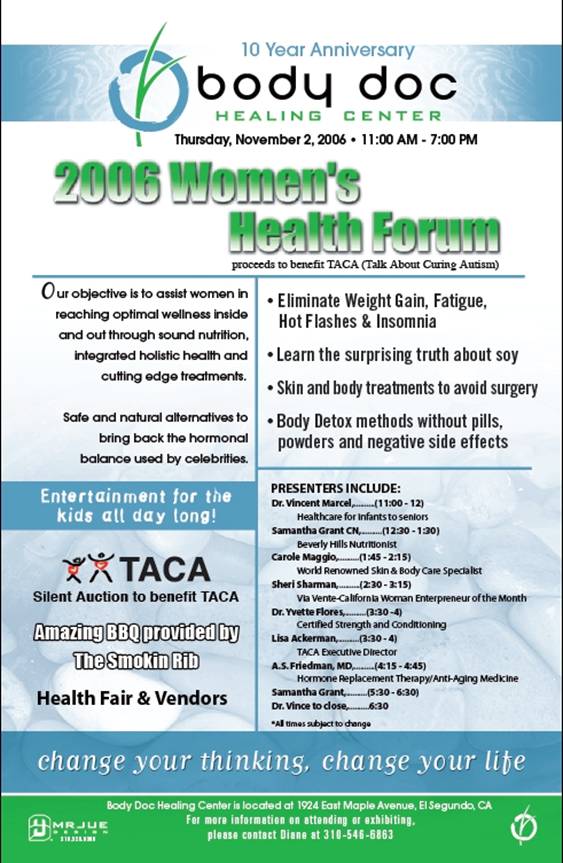
Outreach Clinic For Children with Autism,
PDD, AD(H)D, and Behavior Disorders
Being held in Temecula, CA
Friday, November 3, 2006
Dr. Kurt Woeller’s Office
Stillpoint Center for Integrative Medicine
32605 Highway 79 South # 201
Temecula , CA 92592
Please contact Sarah Wickens or Linda Brozanic if you have any questions and/or to schedule appointments at 913-341-8949.
Dr. Kurt Woeller (DAN! Practitioner) will be seeing patients on Friday from 8:30am - 5:00pm.
Our goal is to help children with Autism, PDD, Allergies, AD(H)D, and behavioral abnormalities improve their health and well being.
Kurt N. Woeller, D.O. is an osteopathic physician who specializes in traditional osteopathic medicine, cranial osteopathy and integrative medicine. His primary focus is treating children with autistic-spectrum disorders. He graduated in 1995 from the University of New England, College of Osteopathic Medicine (UNECOM) in Biddeford, Maine. After completing his postgraduate training in 1996 from Mesa General Hospital in Arizona he returned to San Diego, CA to begin private practice. He currently lives and practices in Temecula, CA.
Dr. Woeller began his study of natural medicine in 1992 as a second year medical student. Realizing his training within medical school was severely lacking in the area of nutrition, natural, and integrative medicine, he began a pursuit of self-education to learn about the many alternative and complementary therapies available to treat and prevent disease. He has worked as a staff physician at the Southwest Naturopathic Medical Center in Scottsdale, Arizona and as a contributing osteopathic assistant for the Foundation of Osteopathic Research and Training (FORT), a training program dedicated to teaching the principles of traditional osteopathic medicine. Since 1998, Dr. Woeller has been a referral physician for DAN! (Defeat Autism Now), an organization of doctors dedicated to the biomedical assessment and treatment of children with autistic-spectrum disorders.
Dr. Woeller is currently the Medical Director for Stillpoint Center for Integrative Medicine, a multi-faceted health clinic in Temecula, CA. He also works as a consulting physician with BioHealth Diagnostics, a renowned functional medicine diagnostic testing and consultation company. He continues to teach other physicians through seminars and individual training regarding the assessment and treatment of patients with chronic illness.
Dr. Woeller is also the 'Autism Outreach Clinical Director' for the Great Plains Laboratory outreach clinics. These clinics provide patients access to sophisticated testing and treatment options in underserved areas of the country. These clinics have provided thousands of parents with autistic-spectrum children the ability to work with doctors trained by Dr. Woeller in the biomedical approach to autism. In addition, Dr. Woeller serves as a clinical consultant for Great Plains Laboratory teaching doctor’s the latest in biomedical diagnostic testing and treatment protocols for children with autistic-spectrum disorders. He lectures nationwide for Great Plains Laboratory, as well independently regarding the benefits of biomedicine for children with autism.
The Great Plains Laboratory has enacted a policy requiring each outreach clinic to have a minimum of 10 patients signed up 14 calendar days before the clinic date. Such policies must be enforced in order to prevent last-minute sign-ups and to make the accurate planning of such events possible. This does not mean that we will not take appointments after the 14-day cutoff, but we ask that patients make their appointments as soon as possible in order for us to ensure that the clinic will take place.
In the case of a cancellation, you must contact Sarah Wickens at 913-341-8949 within 72 hours of the appointment. Failure to do so could result in a charge to your credit card for the $200 doctor consult fee.
TOY TIPS FOR KIDS WITH SPECIAL NEEDS on NOVEMBER 7th
The Grandparent Autism Network, an Orange County nonprofit support group exclusively for grandparents of children with autism, announces the presentation, Toy Tips: Ideas and Options for Children with Special Needs on Tuesday, November 7, 2006 from 1:00 p.m. – 3:00 p.m. The meeting will be held at Team of Advocates for Special Kids (TASK), 100 W. Cerritos Avenue, Bldg. #3, Anaheim, CA., located at the corner of Anaheim Boulevard and Cerritos, one mile east of Disneyland. There is no charge for admission. Grandparents will receive suggestions as to which types of toys will work best for their grandchildren. “This will be especially helpful for grandparents as the holidays approach. We don’t want to frustrate our grandchildren by choosing inappropriate toys and we hope to avoid making costly mistakes,” said Bonnie Gillman, founder of the Grandparent Autism Network.
The program is presented by Laura Simmons-Martinez, Technology Project Director at TASK, a non-profit parent training and information center that serves all ages and all disabilities. Following the presentation, grandparents will tour the on-site Tech Center which provides scheduled access to computers and adaptive technology.
The purpose of the Grandparent Autism Network is to help grandparents learn more about autism and how to be most helpful to their families. Together, grandparents increase resources, awareness and support for autism causes. If you are unable to attend this meeting but would like more information about the Grandparent Autism Network, please call (714) 573-1500 or e-mail: gangrandma@cox.net.
Special Needs Trust Seminar on Wednesday, November 8 th at 7 pm at Us Too Gymnastics, 25 Spectrum Point Drive #405 in Lake Forest; (949) 716-1970. US Too Gymnastics is a great facility that teaches gymnastics to children who have Autism and other special needs. The seminar and informational folders are free, and we will provide desserts and beverages. RSVP’S ARE REQUIRED
emccoy_esq@adelphia.net
Elizabeth C. McCoy
Attorney At Law
2449 Trails End
Fallbrook , CA 92028-8651
www.ca-specialneedstrusts.com
760.723.8906
November 15, 2006
6:30-8:00 P.M.
More Than Just Coping :
Empowerment Strategies for Parents
by Chantal Sicile-Kira

Presents The San Francisco East Bay
Autism/Aspergers Conference
December 1-2, 2006
Alameda County Fairgrounds in Pleasanton , CA
Featuring national speakers:
-
Barbara T. Doyle – Master Teacher
-
Jaquelyn McCandless – Biomedical Testing & Treatments
-
Doreen Granpeesheh (CARD) – Basic & Advanced ABA
-
Jerry & Mary Newport – Successful Living on the Spectrum
-
And many other great speakers!
For Parents, Teachers, SLPs, Other Professionals and Individuals on the Spectrum
Organized by: Autism Conferences
Co-sponsored by:
Arizona State University - Autism/Aspergers Research Program
ASC (Autism Society of California )
CALNAA (CA – National Autism Association)
CAN (Cure Autism Now)
CARD (Center for Autism and Related Disorders)
Future Horizons / Kirkman Labs / TACA (Talk About Curing Autism)
Certificates of Attendance available for Professional Certification (7 hours/day)
CEU's for Speech-Language Pathologists and Audiologists (7 hours/day)
(Continuing Professional Development Provider approved by CA SLP-Audiology Board)
Registration: At www.autism-conferences.com (preferred)
Reginal center # ph 1605
Autism/Asperger’s Conference |
Friday Dec. 1
Early Regular |
Saturday Dec. 2
Early Regular |
Both days
Friday-Saturday
Early Regular |
Total Amount
|
|
Parent |
$90 |
$100 |
$90 |
$100 |
$150 |
$170 |
|
|
2 nd Family Member |
$75 |
$85 |
$75 |
$85 |
$130 |
$150 |
|
|
Professional |
$120 |
$130 |
$120 |
$130 |
$180 |
$200 |
|
|
Respite/ Hab/Student * |
$50* |
$60* |
$50* |
$60* |
$75* |
$90* |
* |
|
People with Autism/Asp. |
$20 |
$25 |
$20 |
$25 |
$30 |
$40 |
|
|
Refunds: 75% prior to November 28; no refunds after November 28 |
Total Amount |
|
Financial aid available for low-income families. To qualify, send copy of your income tax return (front page only) with registration.
For Respite/Hab rate, include a letter from agency stating you work with autisticchildren/adults, and that your salary
is below $15/hour. Register only by mail.
For Student rate, include copy of your transcript showing that you are taking 12 or more credits. Register only by mail.
Mail to Autism Conferences, 3542 Fruitvale Ave. #247 , Oakland , CA 94602 or fax to (925) 465-1536
Questions? Email us at autismconference@gmail.com or call us at (925) 465-1536
Exhibitors: email exhibitors@autism-conferences.com or call 562-864-3049 or fax 562-864-6508
***********************
Location: Alameda County Fairgrounds, 4501 Pleasanton Ave. , Pleasanton , CA 94566 www/alamedacountyfair.com
Comments from Previous Attendees:
- “Great conference – great cross category of speakers.” - Parent
- “2 days very well spent! I received a lot of information useful to the clinic where I work!!” - Psychologist
- “Loved the conference because of the teachable techniques” – Mental health provider
- “I did learn a lot – thanks!” - Teacher
- “This was excellent. I was very pleased.” Speech-language pathologist
- “The handouts are really good.” - Parent
|
|
| |
| 11. |
Personal Note: |
I am getting a lot of calls and emails from folks wishing Jeff well and checking on the results from the recent Thoughtful House trip and procedure that happened late August 2006.
First things first – if you missed “What happened to Jeff?” Please see this link for complete details: http://www.tacanow.com/enewsletters_archive/June_2006_1.htm#10
We went to Thoughtful House and I cannot RECOMMEND THESE WONDERFUL FOLKS MORE THAN THIS! I LOVE THEM AND RECOMMEND THEM! Dr. Krigsman, Anissa, Nora and the Central Park Surgery Center in Austin TX were FANTASTIC!!! I cannot say enough about these folks. I thank them for being here to help our kids.
First and foremost: I am just a mom - I am still learning. Jeff has not yet started the treatment protocol but has been under our DAN! doc Dr Jerry Kartzinel's care for over six years (another love, I tell ya). I will NOT DO all the professionals, science or process justice. I will just let you know about it from a mom’s point of view.
PREPARATION FOR THE PROCEDURE:
In preparation for the colonoscopy and endoscopy, I was a lot more scared of this then I needed to be. A homemade social story and new Game Boy got Jeff totally ready. Follow that with a promise for a fun vacation and he was ready to go.
Here is the summary:
1) We arrived in Austin on a Sunday. The schedule? A doctor check up visit and prep in the hotel on Monday and procedure on Tuesday. A final check up via phone on Wednesday gave us a clear go head to travel home via plane.
2) Fasting for Jeff was easy (from Sunday night til Tuesday afternoon) My husband and I also fasted - it is only fair.
Let me clarify fasting: Fasting meant for one day Jeff could drink CLEAR liquids and eat CLEAR Popsicles. He partook of mango popsicles, diluted pear juice and lots of water. NOTE: NO red liquids or popsicles as that can look like blood in the procedure.
The hotel was kind enough to put a refrigerator in the room for easy access and the FLAGSHIP, amazing Whole Foods Market was just 2 miles away from the Hyatt Hotel on Barton Street – which is also about 10 minutes away from Thoughtful House and another 10 minutes away from the Surgery Center.
3) Doing the Miralax (8 doses in four hours) and 1 enema - easy. Pooping - easy. (Easy for me to say / write -- right??)
4) Going to the surgery center and doing the procedure - easy. Jeff jumped on the exam table in the operating room, lifted up his shirt and said “My name is Jeff. Here is my belly. Are you ready to look at my belly?”
The hardest part: Jeff waking up from the anesthesia. He cried and was very disoriented for about an hour. That passed but was a hard experience – while everything else was easier than expected. Considering overall - this process went VERY SMOOTH and should not be a barrier to finding help for your kid.
On the plane and rental car – with all sorts of stops in between -- Jeff traveled fine and our follow up vacation was a blast.
Note: when Jeff was fasting, he did not seem "better" like some kids I have heard without food hurting his belly - just really lethargic. (So did I, by the way, not eating for some time.)
WHAT’S THE DIAGNOSIS FOR JEFF?
- The endoscopy revealed a polyp in the esophagus - and lymphoid nodular hyperplasia (LNH) in the esophagus - which also included reflux.
- The colonoscopy revealed duodenal lymphoid nodular hyperplasia (LNH - all the stuff Wakefield and now Krigsman talk about in their presentations) and ileitis. But the scope revealed a normal colon.
What I find truly interesting:
a) Jeff has been doing the DAN! “gut” protocol for ALMOST 7 YEARS! (GFCF Diet - love this, it is FOUNDATION OF HEALING! Hyperbaric Oxygen, Secretin, supplementation, methyl B12 injections, chelation, glutathione, allergy elimination and rotation diets. It is probably easier to list what we have NOT done for Jeff than what we HAVE done.) The pictures of his esophagus and gut, then the diagnosis absolutely SHOCKED ME (these written words do not feel strong enough). I felt like someone hit me hard in the stomach. Thankfully, what we have been doing for all these years is very helpful and worth the effort. But there is A LOT more to do. My theory now: know the enemy and know what to do.
b) Based on talks with w/the fabulous Dr. Krigsman - there is much to try and things to do to calm the immune system, deal with inflammation issues (a big issue for a lot of our kids) and treat what is there. Some can be treated and some of it is still being worked on.
c) What is important to note is that our discussions also revealed it does not matter how high functioning or low functioning a child is - this procedure can reveal amazing information to ACT UPON.
WHAT PARENTS CAN DO --
READ! Listen to conference tapes! For gosh sakes - if this effects 80% plus of our kids as suspected - please do not spare any time in ruling this in or out with your child’s primary treating doctor.
By reading and listening you will learn: SYMPTOMOLOGY OF GUT RELATED ISSUES, TESTING AND TREATMENT PROTOCOLS. This new disease is FAR TOO COMPLEX and because I am just a mom, I could not do the description JUSTICE.
READING : www.thoughtfulhouse.org - see specifically http://www.thoughtfulhouse.org/publications.htm for the research publications on this relatively NEW disease.
LISTEN: www.autismone.org – From the Autism One Conference, buy the tapes or CD or MP3 files ($10 each - a bargain for the info) Krigsman and Wakefield 2006 and Wakefield 2005 (three separate talks). You need to have them to fully understand what is going on.
EVERY PARENT SHOULD HEAR THE ABOVE THREE TAPES. There is ONE set in the TACA library in Costa Mesa (no, I cannot reserve them - first come, first served).
Who can do this procedure?
Folks - this is a new disease. My understanding is there are 2 doctors who know what to look for and what to do if they find it -- Dr. Tim Buie out of Boston and Dr. Arthur Krigsman, part time out of Long Island NY AND Austin TX.
I have heard from DOZENS of families about their kids being scoped by local doctors who mean well but do not help or do not find anything. Many of these kids have gone through procedures TWICE to find answers with Dr. Krigsman or Dr. Buie.
We got to Krigsman using Frequent Flier mileage and my hotel coupons from my “working days.” Southwest Airlines will allow families to fly for free for medical emergencies. Insurance is covering most of this procedure as it has its own set of ICD9 and CPT codes with a primary doctor referring to Dr. Krigsman. This trip will cost us similar to what it would cost doing the procedure down the street – only we had the best team knowing what to look for.
And yes -- there are long wait lists for these two doctors. Check with their offices (not me) on availability. It is best to get a referral from your DAN! or treating doctor for insurance purposes.
CLOSING - FINALLY:
Considering Jeff is considered as "high functioning" (WHATEVER THAT IS - he attends typical third grade), it was astounding to me the damage he has and how well he functions. I also am so saddened by the pain he must be feeling and yet he shows his bright and sunny disposition to go to school and do what he does day in and day out. He is my hero.
What also scares me is this:
- God willing and through hard work, we can get our kids "recovered" or "indistinguishable from their peers" and this gut disease makes them more susceptible to other immune-related issues or cancers or God knows what else.
- For the kids that the treatment protocol helps little - prayers are needed. Based on anecdotal parent feedback, many families tell me so far the treatments are helping almost every child - just at different degrees for each child. It scares me to think, is the damage permanent for some of our angels? And at what scope? This thought keeps me awake at night.
The only problem: since my last phone consult with Dr. Krigsman, I have been kind of operating in paralyzed walking trance mode. While the results are still being biopsied to be confirmed – I asked a key question, “Does Jeff look like every other kid you have scoped with measles virus?” The answer was yes. While that does not confirm it is the measles vaccine strain yet and does not confirm that it is the measles virus 100%, I would be willing to bet a large sum of money it is.
- All these years I was scared to find the answer of the "enemy" affecting my child. I also built up this procedure in my head as insurmountable, impossible, no way! I am so glad I overcame those issues. I truly know this will be an invaluable step for treating my son. I cringe to think how many kids are not being looked at or symptoms are being ignored.
Bottom line: I give up looking for answers when I am dead. I will keep pushing hard on finding things. I learn something new almost every day. I will be sharing them every step of the way. Hopefully the sharing helps and takes the mystery out of something that SEEMS scary.
Special nods to Dr. Wakefield - I am a big fan. Without him, I shudder to think about the Dark Ages we would be in... maybe we are now in the Renaissance period?? One can only pray. We would be lost without him.
MY ONLY WISH: I WISH I DID THIS PROCEDURE SOONER. Maybe it will make sense to some families and get them motivated to take the step and help treat their child on his/her gut issues. That is why we share. That is the call of the families who read this note and the doctors who help them. I wish there were some down the street ready to go – but that is not the case yet.
That stone unturned? Right now my toe is stubbed on it. Or should I say broken with a big cast? I have a lot more reading, learning, research to do and protocols to try....and I AM NO EXPERT ON THIS. If you have questions, please direct them to the smart guys mentioned in this note, not me...I am still learning.
Special nods to Jeff’s friend Ian and his mom, Elizabeth – thank you. The OC Register article on October 2 (October eNews 2006 #1) is amazing. I hope it inspires other families to reach out to families like mine. Ian and Jeff have a similar bond – just to be friends and find friends. I am so thankful my son Jeff has found a good friend like Ian.
Your friend on the journey,
Lisa A
Jeff & Lauren’s mom, Glen’s wife
Hugs, thanks, and BE SAFE
Lisa A Jeff's mom
And Editor: Kim Palmer (thanks Kim!) |
|
| |
Web Page for TACA Group: www.tacanow.com
check it out and let us know your thoughts
Talk About Curing Autism (TACA) provides general information of interest to the autism community. The information comes from a variety of sources and TACA does not independently verify any of it. The views expressed herein are not necessarily TACA’s. TACA does not engage in lobbying or other political activities.IF YOU DO NOT WANT TO RECEIVE THESE EMAILS, just respond and I will be happy to remove you from the list.
P.S. TACA e-news is now sent to 2,692 people!
(This number STILL represents 90% families affected by autism and 10% professionals.)
|
|
|